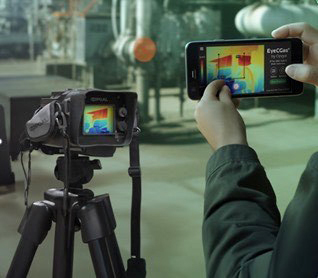
Over the past two decades, Optical Gas Imaging (OGI) has transformed how operators detect and manage hydrocarbon leaks. What began as a military technology has become an essential environmental tool that helps industries minimize emissions, protect workers, and maintain compliance. Today, OGI cameras are critical components of find-and-fix programs that allow operators to identify and repair emissions quickly and effectively.
With increasing regulatory scrutiny and a growing focus on hydrocarbon emissions reductions, including emissions of methane, OGI has become a critical part of leak detection and repair (LDAR) programs across the energy and manufacturing sectors.
As the technology continues to evolve, its role in emissions management and compliance programs has only expanded.
From Thermal Imaging to Transformational Technology
OGI originated from infrared imaging systems developed for military applications. In 2005, FLIR Systems, now Teledyne FLIR, introduced the first spectrally filtered, cooled mid-wave infrared camera, the GasFindIR™, capable of visualizing hydrocarbon gas plumes that are invisible to the human eye.
This breakthrough gave operators a practical way to detect leaks that might otherwise go unnoticed. Today, OGI is widely used across oil and gas, chemical, and manufacturing industries as a proven method for identifying fugitive emissions quickly and cost-effectively.
Benefits to Operators
The value of OGI extends far beyond compliance. By enabling early detection and rapid response, these systems help operators:
- Preserve product by minimizing losses and keeping more material in process
- Enhance worker safety by reducing exposure to pollutants and associated liabilities
- Mitigate fire and explosion risks, which may also reduce insurance premiums
- Protect nearby communities from pollutant exposure and community impacts
- Achieve compliance, operational efficiency, and environmental performance goals
Regulatory Drivers and Acceptance
The first regulatory recognition of OGI came in 2008 when the U.S. Environmental Protection Agency (EPA) issued the Alternative Work Practice (AWP) rule. This allowed facilities subject to federal LDAR requirements to use OGI cameras in place of Method 21 monitoring, within limitations specified by rule.
Since then, OGI has been incorporated into several key regulations, including NSPS Subparts OOOOa/b and Subpart OOOOc Emission Guidelines, which require or permit its use. Other rules, such as Refinery MACT and HON, also allow OGI as an alternative monitoring method if facilities comply with the performance standards in 40 CFR Part 60, Appendix K.
Applications Across the Industry
OGI cameras are now used in a wide range of industrial applications, including:
- Hand-held inspections for periodic LDAR screening
- Fixed installations for continuous site monitoring
- Drone- and aircraft-mounted systems for large-scale surveys and precise location of emission sources identified by downwind sensors
Manufacturers of OGI cameras include Teledyne FLIR, Opgal Optronic, SENSIA Solutions, ChampionX, Sierra-Olympia, ICI, Honeywell, Kuva Systems, CI Systems, and Exosens. Today, FLIR and Opgal are the most widely used OGI cameras for LDAR programs in the United States.
The Rise of Quantitative OGI (QOGI)
The latest evolution in OGI technology is the Quantitative OGI (QOGI) camera. While traditional OGI visualizes gas leaks, QOGI systems estimate emission rates, providing valuable data for emissions inventory and management.
Although current QOGI systems are not yet precision measurement tools, they improve the accuracy and completeness of source-level emission inventories that support the OGMP 2.0 Gold Standard for methane reporting. Opgal and Sensia are leading developers in this area, with FLIR offering QOGI software modules. Independent testing conducted in Europe indicated that Opgal’s technology currently delivers the most accurate results.
How EDGE Can Help
As OGI and QOGI technologies continue to advance, so do the opportunities to integrate them into sustainability, decarbonization, and risk management strategies. EDGE Engineering & Science can help clients evaluate where these tools make sense within their operations and provide guidance through:
- Identifying and assessing potential OGI and QOGI use cases
- Performing cost-benefit analyses and ROI modeling
- Recommending technologies and applications that align with compliance, operational efficiency, and environmental performance goals
OGI has changed how industry sees emissions, both literally and strategically. As detection technology advances, so does the ability to reduce leaks, improve safety, and protect both people and the environment.
Contact EDGE today for #furtherinsight into how OGI and QOGI solutions can strengthen your environmental management program.