
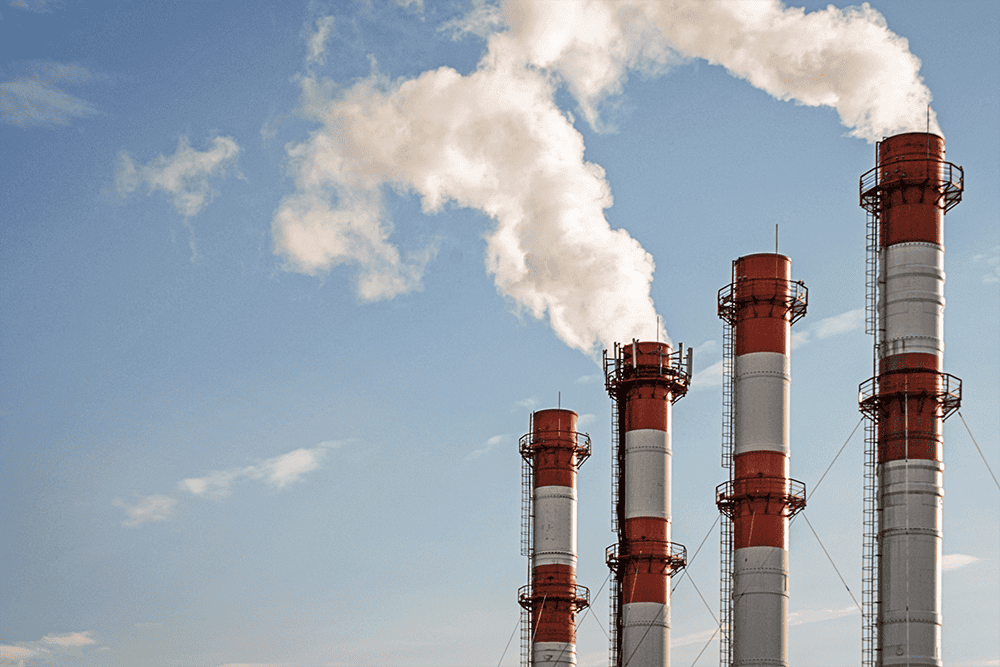
Increasingly stringent PM2.5 standards are creating new challenges for industrial facilities navigating air permitting requirements. As facilities evaluate compliance with the current stringent National Ambient Air Quality Standards (NAAQS) for PM2.5, condensable particulate matter (CPM) is receiving increased attention. This is due to its significant contribution to total PM2.5 emissions and the conservative methods often used to quantify it during emissions analysis.
Increasingly Stringent PM2.5 Standards
Over the past several years, the National Ambient Air Quality Standards (NAAQS) for fine particulate matter (PM2.5) have steadily become more stringent. The most recent revision occurred in 2024, when the U.S. Environmental Protection Agency (EPA) lowered the annual PM2.5 standard from 12 micrograms per cubic meter (µg/m³) to 9 µg/m³. As a result, this reduction has increased the level of scrutiny applied to new projects and facility modifications that require air permitting.
Recently, EPA Administrator Lee Zeldin announced that the agency is revisiting the current annual PM2.5 NAAQS. The agency also plans to release guidance intended to increase flexibility in NAAQS implementation, along with reforms to the New Source Review (NSR) program and additional direction regarding permitting obligations.
Until any future regulatory changes are finalized, facilities must continue demonstrating compliance with the current annual PM2.5 NAAQS of 9 µg/m³. This requirement applies for projects that trigger air quality impact analysis.
Cumulative Analysis and the Growing Role of Background Concentrations
Many permitting actions require a cumulative air quality analysis to demonstrate compliance with the annual PM2.5 standard. These analyses evaluate the combined impact of emissions from the proposed project. In addition, emissions from nearby sources significantly impacting within the project’s area of impact, and ambient background PM2.5 concentrations are included.
To demonstrate compliance, the total of these contributions must remain below the applicable NAAQS threshold. In many areas, background PM2.5 concentrations have shown a rising trend over the past five years. As background concentrations increase, the margin available for project’s emissions decreases. Therefore, it becomes more difficult for projects to demonstrate compliance with the annual PM2.5 NAAQS. As a result, projects often must reduce PM2.5 emissions more aggressively than in the past.
Primary and Secondary PM2.5 Emissions
PM2.5 emissions from industrial sources include both primary and secondary particulate matter. Primary PM2.5 emissions consist of particles that are directly emitted from the exhaust stack of an emission source. In contrast, secondary PM2.5 forms in the atmosphere through complex reactions between precursor pollutants such as nitrogen oxides (NOx) and sulfur dioxide (SO₂). In most combustion applications, primary PM2.5 emissions are orders of magnitude higher than secondary particulate formation.
Primary PM2.5 emissions include two distinct components: filterable PM2.5 and Condensable Particulate Matter (CPM). Filterable PM2.5 consists of solid particles captured during emissions testing. Furthermore, CPM forms when gaseous compounds in the exhaust gas stream condense into particles and aerosols as the exhaust gas stream cools after leaving the stack.
CPM can include acidic salts (e.g., sulfates, nitrates, and chlorides), organic aerosols, and inorganic aerosols (e.g., sulfuric and nitric acid aerosols). Under current regulatory frameworks, all CPM emissions are included in total PM2.5 emissions.
Why CPM Is Receiving Greater Attention
For combustion emission sources, CPM can represent a significant portion of primary PM2.5 emissions. According to EPA’s Compilation of Air Emission Factors (AP-42), the CPM fraction of PM2.5 emissions is several times higher than the filterable PM2.5 fraction for natural gas combustion. Notably, natural gas combustion is one of the most common air emission sources in the industry. Unlike filterable particulate matter, CPM is typically more difficult to control. Therefore, it is an important factor in PM2.5 permitting evaluations.
The CPM emission factor included in AP-42 for natural gas combustion is based largely on testing conducted between 1991 and 1994 using EPA Test Method 202, which was originally developed in 1991. However, this AP-42 CPM emission factor is based on a limited number of tests conducted on older combustion units, which do not reflect the significant advances that have occurred in combustion technology over the past several decades. In addition, Test Method 202 has long been recognized for producing positively biased CPM measurements. This means the results tend to be conservatively high.
EPA issued revisions to the method in 2010 and again in 2017 to reduce this bias. In November 2024, EPA issued additional guidance intended to further reduce measurement bias associated with ammonium sulfate formation during testing.
Even with these improvements, CPM emission factors for natural gas combustion are still widely considered conservative.
Implications for Air Permitting
Because CPM emissions are included in total PM2.5 emissions, the use of conservative emission factors can significantly influence air permitting outcomes. In some cases, these conservative estimates may cause projects to unnecessarily trigger major source status or major modification thresholds. Consequently, they create additional permitting requirements and operational constraints for facilities.
Alternative Measurement Approaches
Industry and EPA are currently evaluating alternative approaches for measuring CPM emissions. One potential approach involves dilution sampling methods, such as EPA Other Test Method 37 (OTM-37), which measure condensable particulate matter in diluted stack exhaust.
Although this approach is still several years away from regulatory acceptance, early studies suggest that dilution sampling methods could produce CPM emission factors an order of magnitude lower than those currently derived using AP-42 factors based on Method 202.
Good Practices for Managing PM2.5 Permitting Risk
Until improved measurement methods are formally adopted, several practices may help facilities avoid unnecessary operational restrictions during permitting.
- Conduct PM2.5 speciation through stack testing
Project specific testing can provide more representative emission data and reduce/eliminate reliance on conservative AP-42 emission factors. - Evaluate project netting opportunities
Structuring a project to net out emission increases may allow facilities to avoid triggering air quality impact analysis. - Limit modeled impacts below the PM2.5 Significant Impact Level (SIL)
Reducing modeled impacts below the annual PM2.5 SIL of 0.13 µg/m³ via refined modeling techniques may eliminate the need for cumulative analysis in some cases. - Critically review background concentrations used in modeling
Background values should adequately represent air quality concentrations within the project’s area of impact and should not be overly conservative. A detailed spatial and temporal analysis and refined modeling to avoid “double counting’ of nearby sources may be necessary to develop an adequately representative background concentration for the cumulative analysis.
Navigating Increasing PM2.5 Constraints
As PM2.5 standards tighten and background concentrations continue to rise in many regions, CPM will play an increasingly important role in air permitting evaluations. Understanding how CPM emissions are measured, how conservative emission factors influence permitting outcomes, and what strategies are available to manage PM2.5 impacts can help facilities avoid unnecessary operational restrictions. Most importantly, it helps facilities maintain regulatory compliance.
For #FurtherInsight on CPM emission characterization, PM2.5 modeling, and air permitting strategies, contact EDGE Engineering & Science.

